The P.A.C.T Model
Redefining Crime Prevention
At Weedman & Co., we go beyond traditional security measures to offer a deep understanding of the psychological underpinnings behind criminal behavior. By studying criminal thinking, we provide our clients with cutting-edge strategies that anticipate and mitigate potential risks effectively. Built upon seven interconnected frameworks, PACT brings together behavioral analysis, environmental assessment, threat identification, vulnerability evaluation, and measurable risk indicators to help organizations identify and address potential threats before they become incidents.
The Journey Behind PACT: From Personal Transformation to Proactive Crime Prevention
The PACT Model (Proactive Analysis for Crime and Threats) is the result of more than 2 decades of dedicated development, research, practical application, and continuous refinement, supported by years of professional experience and study in security, risk management, and crime prevention.
The model was built around a proactive rather than reactive philosophy: identifying vulnerabilities, recognizing behavioral and environmental indicators, evaluating threats, and developing strategies to reduce opportunities for crime before an incident occurs. It incorporates seven interconnected frameworks, a structured risk-scoring methodology, and an approach to measuring substantial compliance. Its development has involved extensive research, approximately 5 years of tracking and refinement, and more than a year and a half of practical walkthroughs and assessments. PACT represents my effort to bring together practical security operations, crime prevention principles, environmental analysis, and enterprise risk management into a systematic and measurable approach.
My journey to developing this model was anything but conventional. As a troubled teenager, I was introduced to Thinking for a Change (T4C), a cognitive behavioral program that challenged me to recognize patterns, identify triggers, stop, think, and make better decisions. Those lessons, particularly the importance of understanding behavior and recognizing the circumstances that influence decisions, stayed with me. What began as an opportunity to change the direction of my own life eventually became a foundation for how I approach security, risk, and crime prevention.
Over the years, I transitioned from those early experiences into security operations, protective services, investigations, risk management, and ultimately professional work in crime prevention. Today, I draw upon that journey, my education, professional experience, and years of research to develop strategies that help organizations better understand and manage risk.
In many ways, PACT brings that journey full circle: taking lessons learned about human behavior and decision-making and applying them toward a greater objective - preserving lives through proactive prevention.
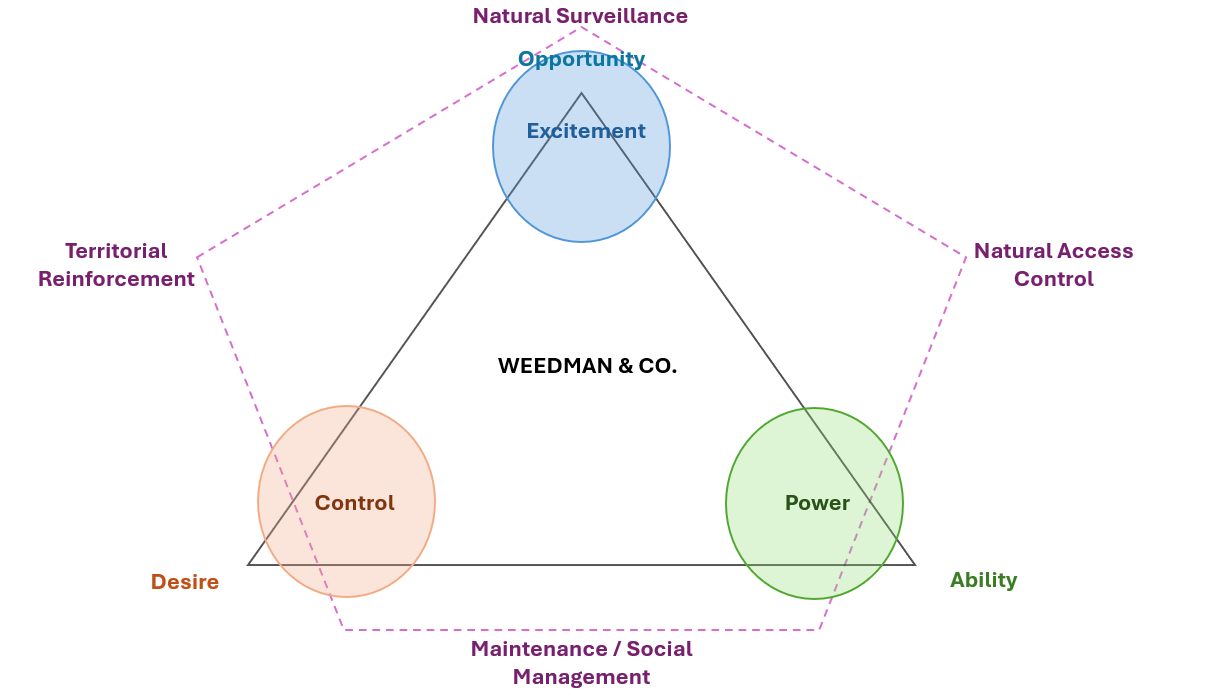
The Three Pillars of PACT: The Foundation of Proactive Crime Prevention

WEEDMAN & CO.
| P.A.C.T. Tier | Criminal Thinking | Crime Triangle | CPTED Integration |
|---|---|---|---|
| Desire | Psychological motivations (Power, Excitement, Control). | Element of Crime Triangle driving offender intent. | Addressed through community design, reducing social factors contributing to desire. |
| Ability | Individual capacity and skills for criminal acts. | Element assessing individual capacity and tools. | Directly influenced by environmental design, including access control measures. |
| Opportunity | Linked to environmental factors providing a chance for criminal acts. | Central element pertaining to circumstances allowing crime to occur. | Primary focus on modifying physical environment to reduce opportunities and enhance safety. |
| Interconnectedness | Psychological drivers contribute to thinking; environmental changes impact behavior. | Emphasizes how desire, ability, and opportunity interact dynamically. | Serves as a practical application bridging the gap between thinking and environment. |
| Implementation | Insights into offender motivations inform targeted intervention. | Crime prevention strategies target specific triangle components. | CPTED encompasses natural surveillance, territorial reinforcement, and access control. |
| Long-Term Impact | Understanding deep-rooted motivations contributes to lasting prevention. | Comprehensive strategies addressing all three triangle elements simultaneously. | Creates enduring, positive physical changes reducing future crime opportunities. |