FL. 768.0706 Multifamily Residential Presumption Against Liability
(C.P.T.E.D.)
Florida State Statue Section 768.0706
Multifamily residential property safety and security: presumption against liability.
By January 1, 2025, the owner or principal operator of a multifamily residential property must have a CPTED assessment conducted and provides proper crime deterrence and safety training to its current employees.

Multi-Family Housing & Commercial Real Estate Underwriting Optimization
In the Florida real estate landscape, property managers and condo boards face an unprecedented crisis regarding insurance availability and volatile premium spikes. We target, work with and mitigate underwriters' core fears: premises liability lawsuits, catastrophic hurricane exposure, slip-and-falls, and third-party violent crime (negligent security claims).
Why Compliance with Florida Statute 768.0706 is Essential for Property Owners
Florida Statute 768.0706 gives property owners a vital opportunity to protect themselves from lawsuits related to third-party criminal acts. Complying with this law offers robust legal protection, helping you avoid costly settlements or jury verdicts that could arise from violent crimes on your property. This is especially important in high-crime areas where the risk of litigation is high. Achieving compliance does come with initial costs. Property owners should budget around $8,000 to $20,000 for legal services and a qualified security consultant to perform the required CPTED (Crime Prevention Through Environmental Design) assessment. Cutting corners by hiring an inexperienced assessor or relying on local police for the CPTED assessment can lead to unrealistic expectations or an assessment that might not hold up in court.
Beyond consulting fees, you should also be prepared for the cost of property improvements needed to meet the statute’s requirements. Typical issues include inadequate surveillance, poor lighting, problematic landscaping, and insufficient access controls. Depending on your property, lighting upgrades might cost between $15,000 and $80,000, camera installations could range from $3,000 to $40,000, access controls might cost $5,000 to $20,000, and landscaping improvements could run from $2,000 to $13,000. While these costs may seem significant, the benefits are important to operations and reduced risk. For example, lower insurance premiums, higher property values, and stronger legal protection—are well worth the investment. Many property owners have already committed to compliance across their Florida portfolios, drawn by the promise of reduced liability and improved safety & security.
By investing in a CPTED assessment from a security and risk management expert you’re not just meeting legal requirements; you're making a strategic choice to protect your property, enhance its value, and ensure peace of mind for the residents. The investment in compliance could prevent a multi-million-dollar lawsuit, making it a smart decision for any property owner. Take the first step today by signing up for a CPTED assessment.
WHAT IS CRIME PREVENTION THROUGH ENVIRONMENTAL DESIGN?

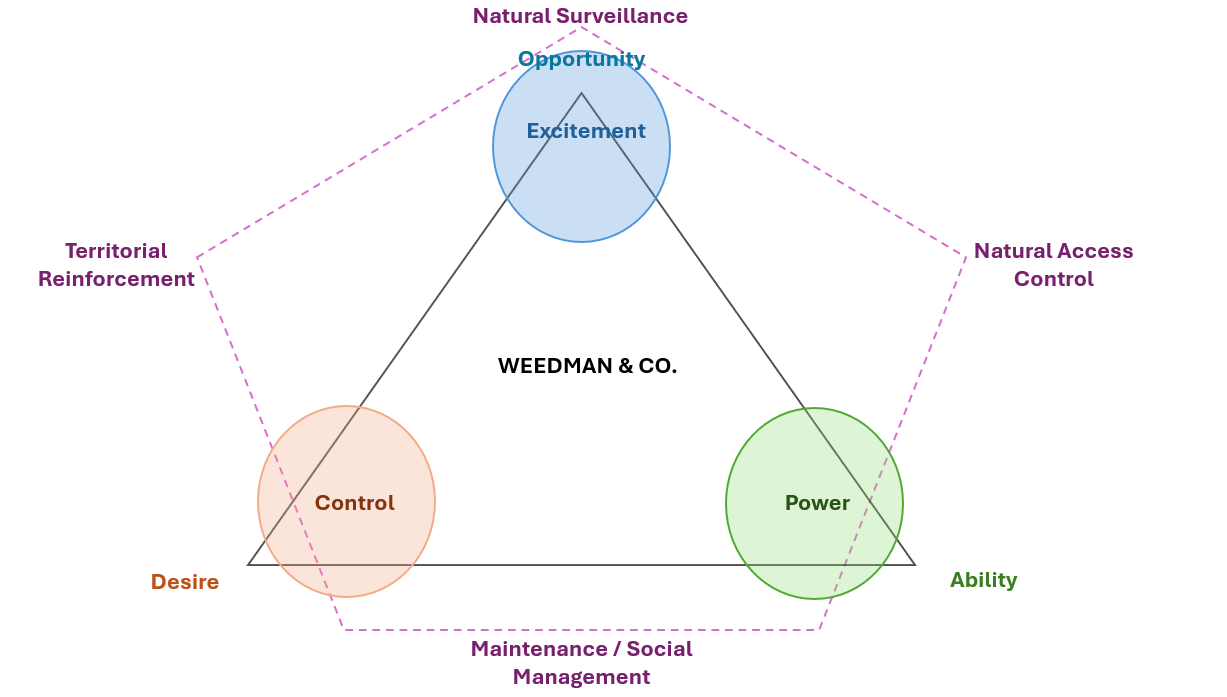
Natural Surveillance
Enhances control by increasing visibility, reducing opportunities for criminal activities to go unnoticed.
• Natural: Utilization of natural elements like landscaping and the built environment to optimize visibility and deter criminal activities.

Territorial Reinforcement
Reinforces control by clearly defining spaces, making it difficult for criminals to manipulate or dominate specific areas.
• Natural: Incorporating landscape design to naturally reinforce boundaries.

Natural Access Control
Mitigates opportunities by restricting entry, limiting the potential for criminals to engage in illegal activities.
• Natural: Utilizing architectural design to control pedestrian and vehicular flow.

Maintenance
Keeping areas well maintained ensures CPTED principles can be effective.
• Natural: Incorporating design elements that are easy to maintain, minimizing potential vulnerabilities.
Maintaining “Substantial” Compliance
At Weedman & Co. each assessment is translated into a structured Risk Score that provides a measurable way to document conditions, improvements, deficiencies, and overall risk exposure. We provide verifiable Advanced micro-level field mapping, applying the "P.A.C.T. Model," published directly by Joseph Weedman of the industry-standard textbook Protection, Security, and Safeguards (3rd Edition). This provides underwriters with empirical proof of Natural Surveillance (via our strict 2-foot / 7-foot landscaping rule) and Territorial Reinforcement. Individual scores are assigned to each assessed area based on documented findings and established criteria, creating an objective record of the property’s performance and progress toward substantial compliance with applicable requirements and recognized standards. These individual scores are then consolidated into an overall Property Risk Score, providing a clear snapshot of the property’s current risk profile. By maintaining this scoring methodology from assessment through the three-year reassessment cycle, we can demonstrate what was identified, what was addressed, what remains outstanding, and how risk has changed over time, creating a defensible record of ongoing risk management, maintenance, improvement and Crime Prevention Through Environmental Design.


Picking a Designated Florida Crime Prevention Specialist
Due to the Florida state statue for the presumption against liability to be recognized the assessment must be done by a designated Florida CPTED (Crime Prevention Through Environmental Design) practitioner. This is crucial for enhancing safety and security in any environment. Florida's unique environmental factors and demographics necessitate specialized expertise in addressing local challenges effectively. Mr. Weedman a designated CPTED practitioner in Florida and expert in security risk management brings in-depth knowledge of the state's urban and suburban landscapes, cultural nuances, and legal considerations, ensuring tailored solutions that resonate with the community. Ultimately, engaging with a Florida CPTED designated practitioner underscores a proactive approach to crime prevention, promoting livable and thriving communities across the state.
A certified FCP (Florida CPTED Practitioner) audit report signed by Joseph Weedman, former Chairman of the U.S. CPTED Association (USCA) Standards Committee. This deliverable embeds directly into the carrier submission package.

Site Assessment & Employee Training
Mr. Weedmans assessment not only identifies potential vulnerabilities but also proposes practical design modifications and behavioral strategies to mitigate risks and foster a secure environment for residents, businesses, and visitors alike.
Our team can help you optimize your operations and streamline your processes to improve efficiency and reduce costs. We provide tailored solutions to meet the unique needs of your business. With our online training we can provide more Indepth training than required by the state in shorter amounts of time. Utilizing an E-learning system we can bring a multitude of different courses right to your employees at work. Train & Test at your speed. While we can ensure annually your employees are actively staying up to date.

Ongoing Progress & 3-Year Reassessment
Following the initial assessment, we track progress over the next three years to ensure recommended improvements remain functional, maintained, and aligned with evolving risks and operational needs.
Throughout this period, we monitor the implementation and condition of identified improvements, helping ensure that corrective actions do not simply get completed, but continue to provide the intended value.
At approximately 18 months, we conduct an interim site walkthrough to review progress, identify emerging concerns, and determine whether adjustments are needed.
At the end of the three-year period, a full reassessment is conducted to evaluate current conditions, measure progress, identify new risks, and establish the priorities for the next assessment cycle.
New Title
The P.A.C.T Model
Redefining Crime Prevention
Criminal Thinking encapsulates the psychological motivations driving individuals towards illegal activities. The triad of Power, Excitement, and Control forms the foundation of criminal thought processes. The Crime Triangle, a conceptual framework in criminology, encompasses three key elements: Desire, Ability, and Opportunity. Integrating this with Criminal Thinking reveals fascinating correlations.
At Weedman & Co., we go beyond traditional security measures to offer a deep understanding of the psychological underpinnings behind criminal behavior. By studying criminal thinking, we provide our clients with cutting-edge strategies that anticipate and mitigate potential risks effectively.

How It Works
1. Contact us
Contact us by phone, email, or via the contact form tp set up your FREE Consultation!
2. Creating a Projected Timeline
Timeline considers factors such as the size of the property, the scope of the assessment, and any specific requirements or deadlines.
3. Scheduling Appointments
Scheduleing appointments with the necessary parties involved in the assessment process.
4. Completing the Deliverables
The duration of the assessment typically ranges from 1 to 3 business days, depending on factors such as the size and complexity of the property.
5. Project ends
We compile the findings and document them according to the requirements and risk score of the assessment. This documentation may include written reports, photographs, or other forms of documentation.